ADUsUpdated 6 min readFloorGen team
Hawaii ADU Rules: Act 39, the 2026 Deadline and Oahu Sizes
Hawaii ADU rules: Act 39 requires two ADUs per urban residential lot by Dec 31, 2026. What counties still decide, and Oahu's 500 and 1,000 sq ft caps.
Hawaii's ADU rules are set by each county, but Act 39 (SB 3202, signed May 28, 2024) requires every county to adopt ordinances allowing at least two accessory dwelling units, or the reasonable equivalent, on all residentially zoned lots in the state urban district. If a county has not done so by December 31, 2026, it may not deny a homeowner's permit for up to two ADUs just because the lot would exceed its unit count. On Oahu today, an ADU can be up to 500 sq ft on lots under 5,000 sq ft and 1,000 sq ft on larger lots. Law current as of October 2026.
This guide walks through what Act 39 says and does not say, Honolulu's current rules, and a 400 sq ft studio plan that fits even the smaller Oahu cap. For the national picture, see which states require cities to allow ADUs.
Hawaii ADU rules under Act 39
Act 39 added a new section to chapter 46 of the Hawaii Revised Statutes (now HRS § 46-4.8), "Accessory dwelling units on residentially zoned lots", and a companion section to chapter 205 on private covenants. It took effect on approval. The main provisions, from the session law text:
| Topic | Rule |
|---|---|
| Main duty | Each county adopts or amends ordinances with reasonable standards allowing at least two ADUs, or the reasonable equivalent, on all residentially zoned lots [b] |
| Alternative | A county that does not do that must instead define districts allowing two ADUs per existing house, spread across the county and near transit stations and major arterials [c] |
| Deadline | If no compliant ordinance by December 31, 2026, the county may not deny a permit for up to two ADUs on the basis of exceeding the maximum number of units, until it adopts one [g] |
| What counties keep | All county development standards still apply [e]; permits may be denied for insufficient utility infrastructure [f], or on infrastructure, design or development standards after the deadline [g] |
| Rentals | Counties may not ban separately leasing any unit on a residential lot as a long-term rental [h] |
| Exclusions | Land outside the state urban district, special management areas, and urban areas at high risk of flooding, lava or fire [i] |
| Which lots | Zoning lots in districts principally for single- and two-family detached homes; not rural or low-density districts [k] |
| Vested rights | None created; counties still review and may deny permits [j] |
The companion section in chapter 205 says that no private covenant recorded after the Act's effective date may limit the number of ADUs on a residentially zoned urban lot below the state number, or ban long-term rentals there. Covenants recorded before May 28, 2024 are not affected, so an older subdivision's CC&Rs can still bar a second unit.
Oahu: Honolulu's current ADU rules
Honolulu rewrote its use regulations in Ordinance 25-2, now Article 5 of the Land Use Ordinance, with the ADU standards in LUO § 21-5.50-3(a). It took effect in 2025 and raised the size caps that had applied since the 2015 ADU ordinance (400 and 800 sq ft):
| Rule | Requirement |
|---|---|
| Size, zoning lots up to 4,999 sq ft | Total floor area of the ADU no more than 500 sq ft |
| Size, zoning lots of 5,000 sq ft or more | Total floor area no more than 1,000 sq ft |
| Number | One ADU per zoning lot; an ohana unit otherwise permitted on the lot is not counted as the ADU |
| Form | New attached or detached structure, or conversion of a legal structure, attic or basement |
| Standards | Must meet all development standards for the principal use in the zoning district |
| Not permitted | In planned development or cluster housing, or on landlocked lots |
| Infrastructure | Only where wastewater, water, roads and first-responder resources are sufficient |
| Covenant | Recorded covenant: long-term occupancy only (no bed and breakfast or transient vacation use), and no condominium split of the ADU from the house |
So on Oahu today the usual way to get two extra homes on a lot is one ADU plus an ohana unit (a second dwelling with its own rules, including that occupants be related to the main household), not two ADUs. Honolulu will have to amend the LUO again, or rely on the reasonable-equivalent wording, to meet Act 39 by December 31, 2026. Maui, Hawaii and Kauai counties have their own ADU and ohana ordinances and their own amendments in progress; check the county planning department.
A 400 sq ft studio that fits the smaller cap
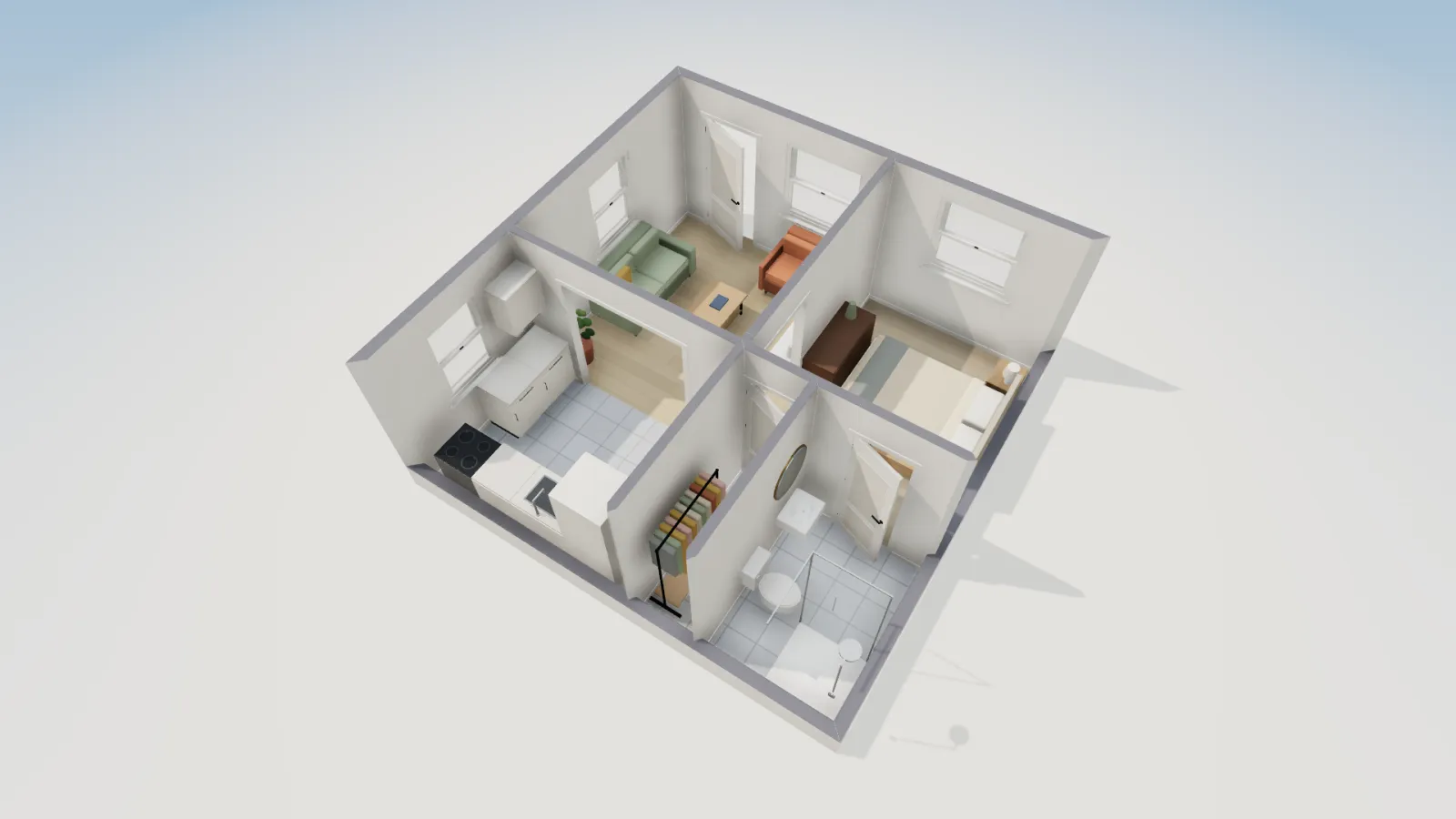
Many older Oahu lots are under 5,000 sq ft, which puts them in the 500 sq ft tier. FloorGen's 2-car garage to studio ADU template is about 422 sq ft to the outside of its walls and 361.3 sq ft of net floor area, so it fits under 500 sq ft whichever way the floor area is measured. It works as a converted carport or garage, or as a new detached studio.
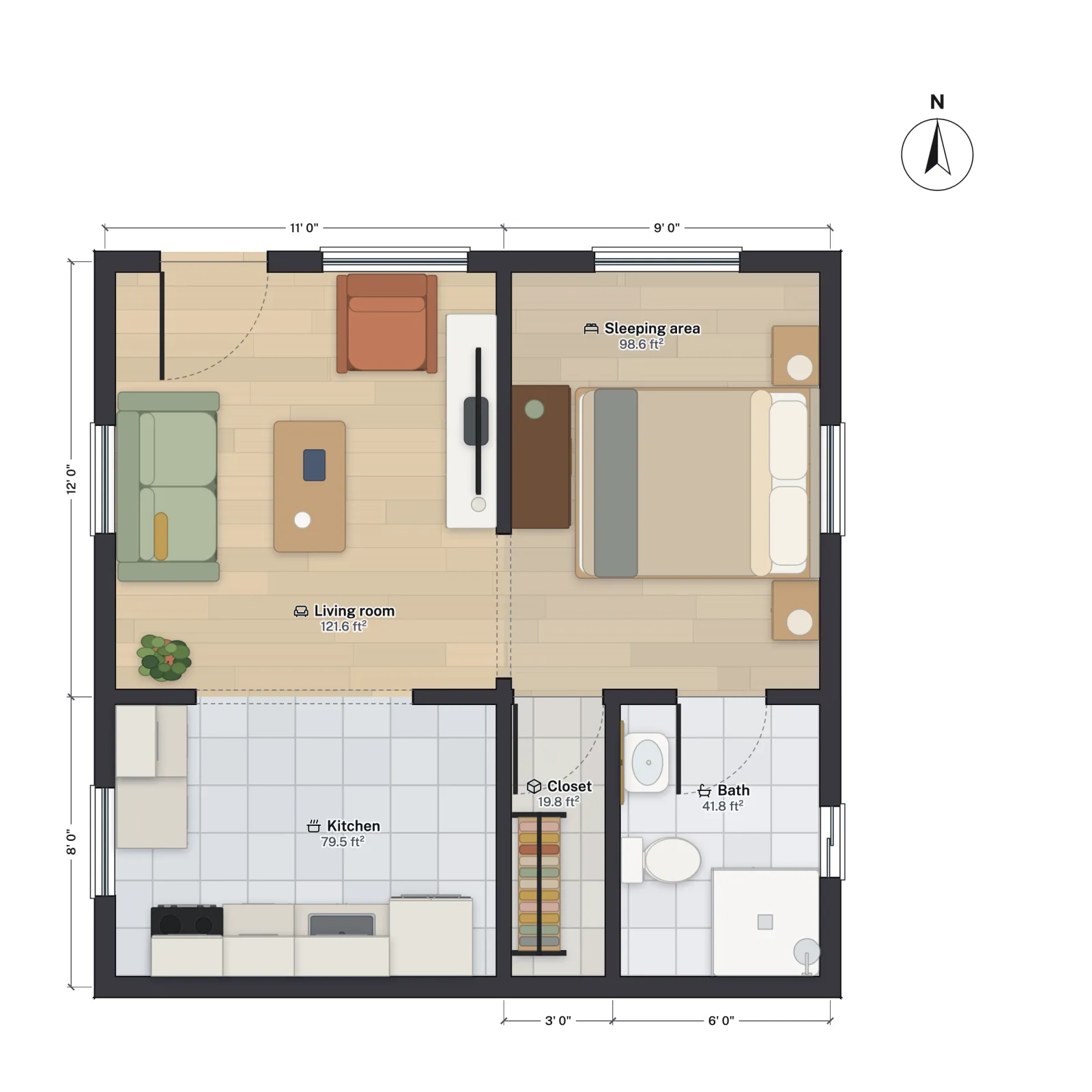
| Room | Net area |
|---|---|
| Living room | 121.6 |
| Sleeping area | 98.6 |
| Kitchen | 79.5 |
| Closet | 19.8 |
| Bath | 41.8 |
| Total, net | 361.3 |
| Outside the walls | 422 |
That leaves about 78 sq ft of headroom under the 500 sq ft cap if floor area is counted to the outside of the walls: enough to add a covered lanai (check whether Honolulu counts it as floor area) or deepen the kitchen. On a 5,000 sq ft lot or larger the cap doubles to 1,000 sq ft, which leaves room for a one- or two-bedroom unit. Two of these studios on one lot is the kind of "two ADUs" Act 39 has in mind, once your county's ordinance allows it.
Building code, wastewater and permits
- Building code. Hawaii adopts the International Residential Code with state and county amendments. An ADU needs habitable rooms of at least 70 sq ft and 7 ft wide (2021 IRC R304) and an escape opening for the sleeping area (2021 IRC R310); see legal bedroom requirements.
- Wastewater. Many lots outside the sewered core use cesspools or septic systems, and new cesspools are not allowed. Wastewater capacity is a common reason an ADU is refused, and Act 39 keeps that reason available to counties.
- Fees. Act 39 also amended the impact fee law (HRS 46-143) to add the square footage of the development as a factor, deducting an existing structure's area when it is converted.
- Drawings. A site plan with setbacks and a floor plan are the core of the permit set; see how to draw floor plans for a building permit.
FloorGen's IRC profile checks room areas and widths, ceiling heights, bedroom escape windows, stairs and door swings. It does not check county zoning, floor-area definitions, setbacks or wastewater. For a state that already allows two ADUs per lot, see Washington's ADU law; for another state whose ADU mandate took effect in October 2026, see Utah's SB 284.
More from the blog
ADUs6 min read
ADU Laws by State: Which States Require Cities to Allow ADUsADUs6 min read
Washington ADU Law (HB 1337): Two ADUs Per Lot ExplainedADUs6 min read
Hawaii ADU Rules: Act 39, the 2026 Deadline and Oahu Sizes