Codes6 min readFloorGen team
GFCI and AFCI Requirements by Room (NEC 2023)
Where GFCI outlets are required under the 2023 NEC, room by room: kitchen, bath, laundry, garage, basement, outdoors, crawl space, plus where AFCI applies.
Under the 2023 National Electrical Code (NEC), GFCI protection is required for receptacles in dwelling-unit bathrooms, kitchens, laundry areas, basements (finished or not), garages, crawl spaces and outdoors, and within 6 ft of a sink or a tub or shower. AFCI protection (210.12) covers a different list: nearly every habitable room, plus hallways, closets and laundry areas, but not bathrooms, garages or outdoors. Which edition applies to you depends on your state, so check that before you rely on any number here.
GFCI vs AFCI in one minute
A GFCI (ground-fault circuit interrupter) trips when current leaks to ground, for example through a person standing on a wet floor. It is about shock, so it follows water and damp concrete. An AFCI (arc-fault circuit interrupter) trips on the sparking of a damaged cord or a loose connection. It is about fire, so it follows the rooms where people sleep, sit and plug things in. A dual-function breaker or device does both, which is how a kitchen or laundry circuit usually meets both rules.
GFCI and AFCI by room (2023 NEC)
GFCI is in 2023 NEC 210.8(A), which covers 125 V through 250 V receptacles in dwelling units. AFCI is in 2023 NEC 210.12(B). The table summarises both; paraphrased, so read the adopted text for exceptions.
| Location | GFCI | AFCI |
|---|---|---|
| Kitchen | Yes, every receptacle (210.8(A)(6)) | Yes |
| Bathroom | Yes (210.8(A)(1)) | Not on the list |
| Laundry area | Yes (210.8(A)) | Yes |
| Garage | Yes (210.8(A)(2)) | Not on the list |
| Basement | Yes, finished or not (210.8(A)(5)) | Yes, in finished living space |
| Outdoors | Yes (210.8(A)(3)) | Not on the list |
| Crawl space | Yes, at or below grade (210.8(A)(4)) | Not on the list |
| Within 6 ft of a sink | Yes (210.8(A)) | Per the room |
| Living, dining, bedroom, hall, closet | Not unless a rule above applies | Yes |
Three details trip people up. The 6 ft for a sink is measured from the top inside edge of the bowl, and for a tub or shower from its outside edge. A garage rule applies to garages and to accessory buildings with a floor at or below grade. And a laundry area is a laundry area wherever the washer sits, not only in a room labelled Laundry, so a washer in a hallway closet counts. The AFCI list is written as kitchens, family rooms, dining rooms, living rooms, parlors, libraries, dens, bedrooms, sunrooms, recreation rooms, closets, hallways, laundry areas "or similar rooms or areas".
What the 2020 and 2023 editions added
- 2020, voltage scope. GFCI in dwellings now covers 125 V through 250 V receptacles on single-phase circuits of 150 V or less to ground, no longer only 15 A and 20 A, 125 V ones. A 240 V dryer or range receptacle in a protected location is now caught.
- 2020, indoor damp and wet locations. A new item for dwelling-unit indoor damp and wet locations. Mudrooms and pet-wash areas are the usual debate; the inspector decides.
- 2023, kitchens. The old limit to receptacles serving the countertop was removed, so all kitchen receptacles need GFCI protection (see kitchen outlet spacing code).
- 2023, food and drink prep areas. A new item for areas with a sink and permanent provisions for food preparation, beverage preparation or cooking. That catches wet bars and butler pantries without relying on the 6 ft distance.
- 2023, outdoor outlets. Trade summaries of the 2023 edition say the outdoor-outlet rule (210.8(F)) was widened to cover more than the house itself; check the wording in your adopted edition.
- 2023, AFCI. 210.12 was reorganised into dwelling units, dormitories and other occupancies, added sleeping quarters in some institutional buildings and set out a separate subdivision for extensions and modifications of existing branch circuits.
The AFCI dwelling list has been broadly stable since the 2014 edition; most of what changed in 2020 and 2023 is on the GFCI side.
Which edition does your state use?
As of July 2026, the Electrical Toolbox tracker lists 35 states on the 2023 NEC, 7 on the 2026 edition and the rest on 2020 or older. Counts and dates differ between trackers, and some states leave the electrical code to cities and counties. A state that adopted the 2020 NEC has the damp-location and 250 V rules but not the 2023 kitchen and food-prep items. This post covers the 2023 text; where the 2026 NEC is in force, item numbers and some rules differ, so read that edition. Check the current list on Electrical Toolbox, then ask your local building department which edition and amendments it enforces.
Walking the finished basement
FloorGen's 3-bed ranch with a finished basement is a good test, because a basement mixes finished rooms and utility space. The basement is about 1,596 ft² net (areas below are net, to the inner wall faces; the dimension strings in the image run along wall centrelines).
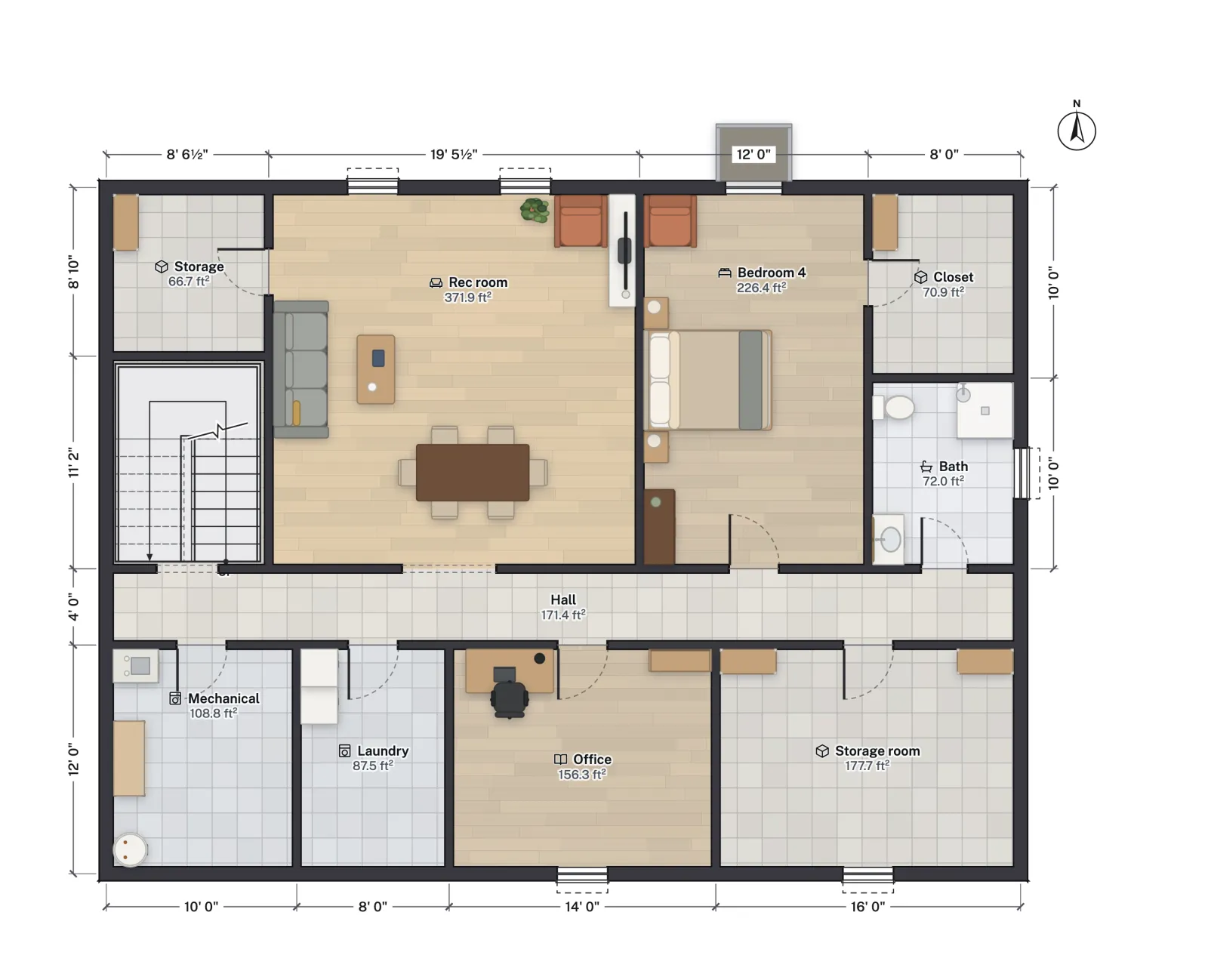
- Whole basement, GFCI. 210.8(A)(5) covers every receptacle in a basement, finished or not. Every room below, including the hall, needs GFCI-protected outlets, unless a listed exception applies (the exceptions are narrow; ask your inspector).
- Rec room (371.9 ft²) and Bedroom 4 (226.4 ft²). These are the AFCI rooms. With basement GFCI too, each circuit needs protection against both faults, so a dual-function breaker or device is the usual answer. Receptacle spacing follows the 6 ft rule in outlet spacing for living rooms and bedrooms.
- Closet (70.9 ft²), Hall (171.4 ft²) and Office (156.3 ft²). Closets and hallways are named on the AFCI list, and an office is a "similar room" in most inspectors' eyes. Treat all three as AFCI areas.
- Bath (72 ft²). GFCI under both the bathroom rule and the basement rule. Bathrooms are not on the AFCI list, but check how the bath circuit is fed.
- Laundry (87.5 ft²). GFCI (basement and laundry area), AFCI (laundry areas are on the list) and the laundry circuit rules in laundry room dimensions apply together.
- Mechanical (108.8 ft²), Storage (66.7 ft²) and Storage room (177.7 ft²). GFCI because they are in the basement. AFCI turns on whether the space counts as a "similar area"; unfinished storage often does not, finished storage may. This is a place inspectors differ, so ask.
- Stair (86.3 ft²). A stairway is not a listed room, but a receptacle in the stair hall is part of the hallway and basement rules.
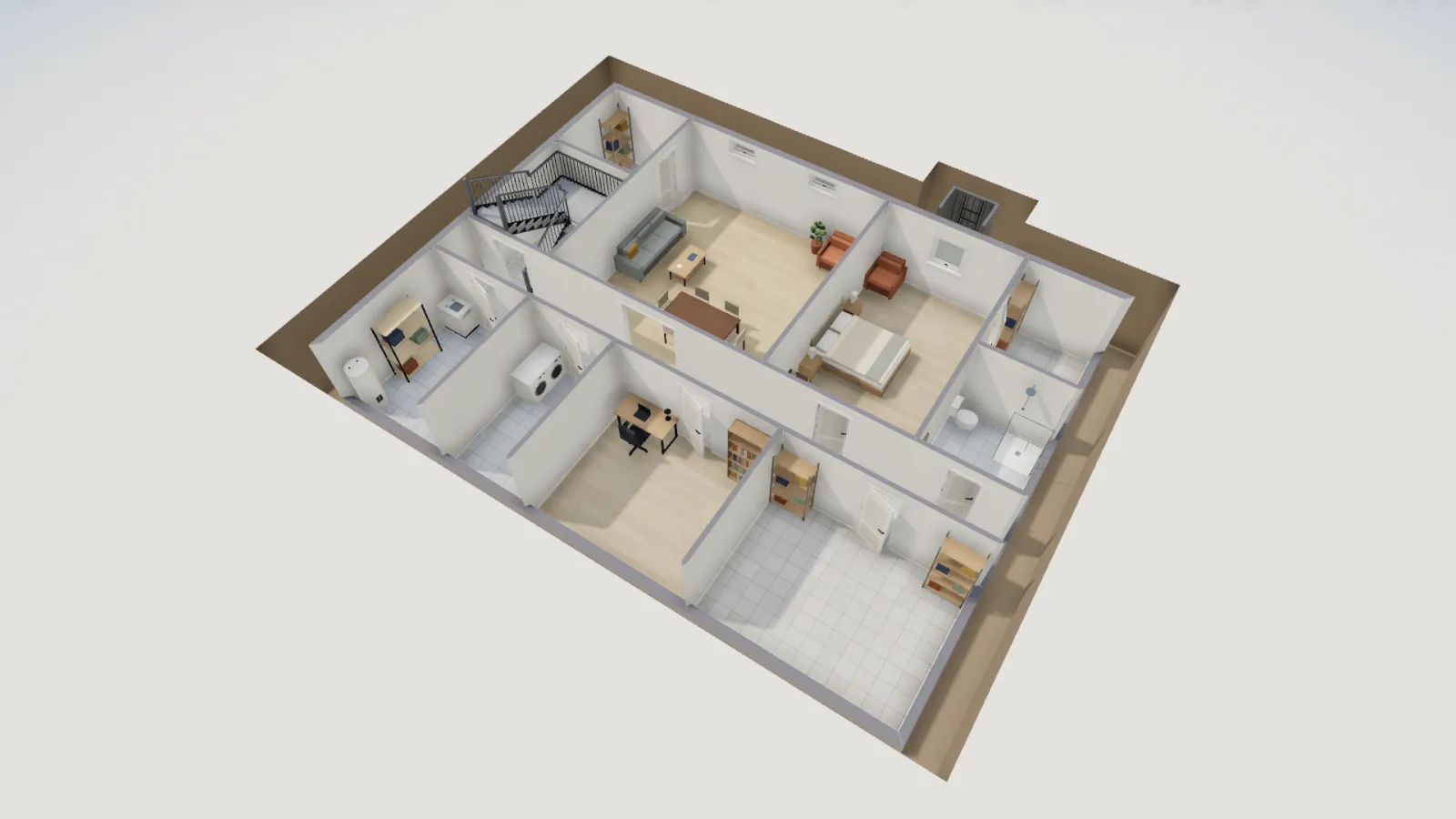
The upstairs follows the same logic: the garage and its outdoor outlets need GFCI, the kitchen needs it on every receptacle, and the bedrooms and living areas need AFCI. For the finished-basement layout itself, see finished basement floor plans.
Planning tips
- Mark GFCI and AFCI rooms on the plan before the electrician quotes. Dual-function breakers cost more than standard ones, and a basement full of finished rooms needs many.
- Decide between GFCI breakers and GFCI receptacles early. A breaker sits in the panel and is easy to reset; a receptacle behind a washer is not.
- Test every GFCI and AFCI after installation with its test button, and again as the manufacturer instructs (monthly is the usual advice for GFCIs). They fail like any device.
- Existing houses: extending or modifying a circuit in an AFCI area usually triggers current AFCI rules for that circuit. Ask your inspector.
More from the blog
Codes7 min read
Outlet Spacing Code for Living Rooms and Bedrooms
Codes6 min read
Kitchen Outlet Spacing Code: NEC Countertop Receptacle RulesCodes6 min read
GFCI and AFCI Requirements by Room (NEC 2023)