ADUsUpdated 7 min readFloorGen team
Texas ADU Rules: Austin, Houston, Dallas & San Antonio (2026)
Texas has no statewide ADU law, so city rules and deed restrictions decide. What Austin, Houston and San Antonio allow, and an 800 sq ft plan to start from.
Texas has no statewide law that forces cities to allow accessory dwelling units. A 2025 bill that would have done so, SB 673, passed the Senate but never got a vote on the House floor. So whether you can build a backyard cottage, garage apartment or "granny flat" in Texas depends on three things: your city's zoning (if it has any), your deed restrictions or HOA, and the residential building code your city has adopted. Law current as of October 2026: the Legislature does not meet in regular session again until 2027.
This guide covers what the 2025 session did and did not change, the rules in Austin, Houston and San Antonio, what to ask in Dallas and the suburbs, and an 800 ft² two-bedroom plan you can open and adjust to your lot. For the states that did pass mandates, including Florida's 2026 by-right law and Arizona's casita law, see ADU laws by state; North Carolina's ADU rules, like Texas's, are still set city by city.
What happened to the statewide ADU bill
SB 673 (89th Legislature, 2025) would have barred cities and counties from prohibiting an ADU on a lot zoned for a single-family home or duplex, from requiring the owner to live on the property, and from banning the ADU being rented. It kept HOAs and deed restrictions in force. The Senate passed it in April 2025; in the House it was reported from committee and placed on the calendar on May 26, 2025, and the session ended before it was taken up (bill history).
Two other housing bills did pass the Legislature in 2025: SB 15, which limits minimum lot sizes in new subdivisions of five acres or more in the largest cities (cities of at least 150,000 people in counties of at least 300,000) to no more than 3,000 ft², and SB 840, which opens commercial land to apartments and mixed use. Neither creates a right to an ADU on an existing lot. Expect an ADU bill to come back in a future session, and check the current law before you rely on this summary.
Austin: three units on most lots
Austin made the biggest change in the state. Its HOME amendments (Home Options for Middle-Income Empowerment), adopted by the City Council in December 2023, allow up to three housing units on most lots zoned SF-1, SF-2 and SF-3, where one or two were allowed before. That can be a house with two ADUs, a duplex plus a third unit, or three small houses. HOME also dropped the cap on unrelated adults living together. HOME Phase 2, approved in May 2024, cut the minimum lot size for a single house in those zones from 5,750 ft² to 1,800 ft², which makes it easier to split a lot so a backyard home can be sold on its own lot.
Unit sizes in Austin are governed by floor-area ratio and the site development standards for each zone, not by a single ADU cap, so the size you can build depends on your lot. The city's HOME amendments page has the current standards and how they apply to two- and three-unit sites.
Houston: no zoning, but not no rules
Houston famously has no zoning ordinance, so the city does not tell you which neighborhoods may have a second unit. It does have Chapter 42 of the City Code (subdivision and development rules), which regulates "secondary dwelling units": typical limits cited from Chapter 42 include a maximum size of about 900 ft², side and rear setbacks, and an extra off-street parking space. Read the current Chapter 42 text or ask the Planning and Development Department before relying on any of those figures.
In practice the deciding document in Houston is usually your deed restrictions. Many subdivisions restrict lots to one single-family residence, set minimum house sizes or forbid separate rental units, and the city enforces some deed restrictions itself. If your restrictions are silent on secondary units, Chapter 42 and the building code govern. If they forbid them, no city approval will help.
San Antonio: ADUs by right with an owner affidavit
San Antonio's Unified Development Code (UDC §35-371) allows internal, attached and detached ADUs by right in its residential districts. According to the city's ADU page, an ADU can be up to 800 ft² or 50% of the main house, whichever is larger, up to 1,600 ft², so every lot can have at least an 800 ft² unit. Only ADUs over 800 ft² need a dedicated parking space. San Antonio does require the owner to live on the property: you sign an affidavit that is recorded with Bexar County.
Dallas, Fort Worth and the suburbs
Elsewhere in Texas the rules vary a lot. Some cities allow an ADU in single-family districts only through a special approval, others permit them by right with owner-occupancy, size and parking conditions, and many suburbs tie ADUs to minimum lot sizes. Before you design, ask the city four questions:
- Is an ADU (or "accessory dwelling", "secondary dwelling", "guest quarters") allowed in my zoning district, and is it by right or by special approval?
- What is the maximum size, height and number of bedrooms, and is it measured as floor area or footprint?
- Must the owner live on the property, and may the ADU be rented, including short-term?
- What setbacks, parking and separate utility meters are required?
| City | Allowed? | Size | Owner on site |
|---|---|---|---|
| Austin | Up to 3 units on most SF-1/2/3 lots (HOME) | Set by zone standards and FAR | Not required |
| Houston | No zoning; deed restrictions decide | About 900 ft² cited from Chapter 42 | Check deed restrictions |
| San Antonio | By right in residential districts | 800 ft² or 50% of house, max 1,600 ft² | Required (recorded affidavit) |
| Dallas and others | Varies by district | Varies | Often required |
An 800 ft² ADU plan for a Texas lot
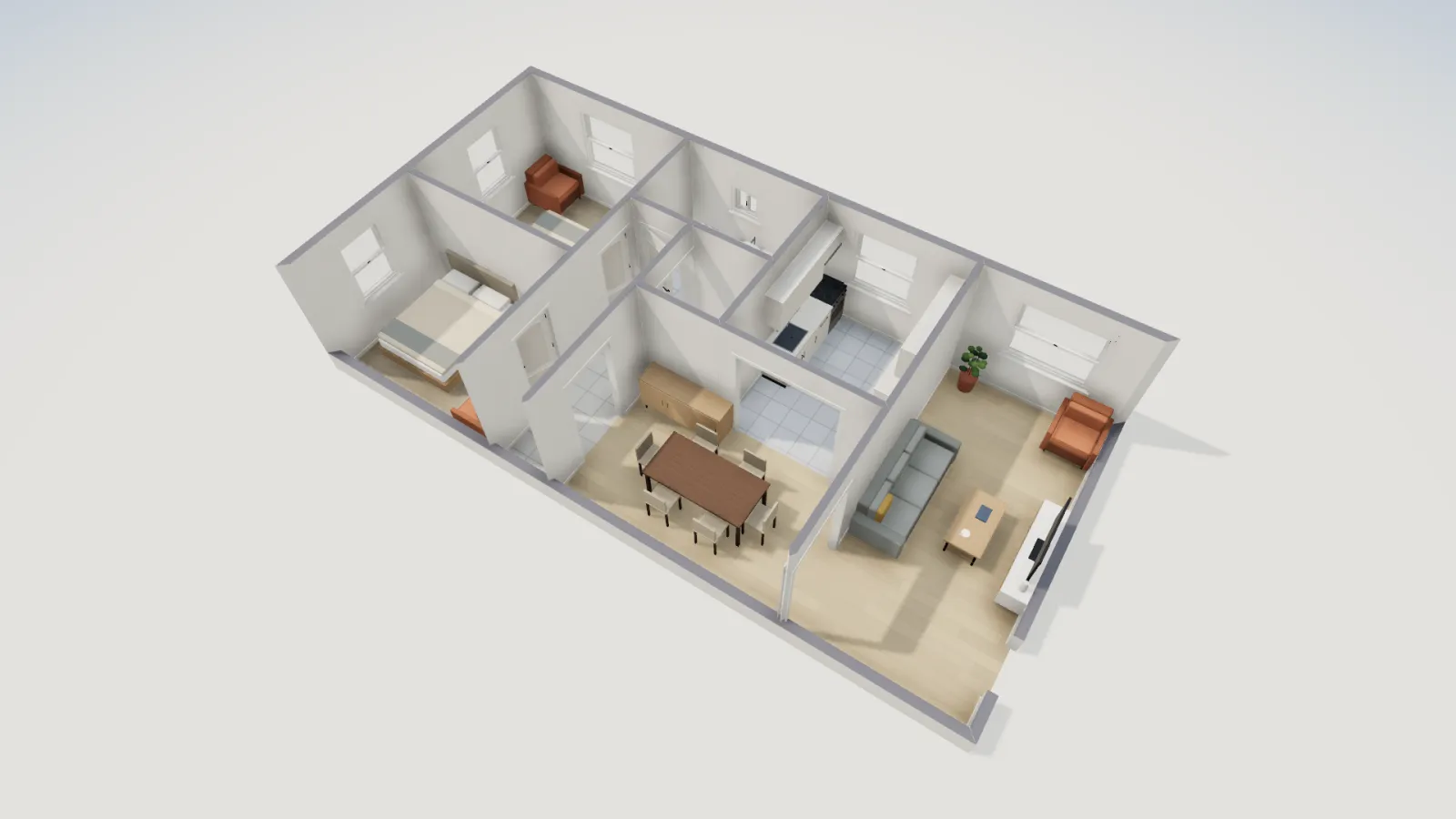
FloorGen's 800 sq ft 2-bed ADU template fits San Antonio's by-right size exactly and sits comfortably inside Austin's and Houston's typical limits. It measures 40 × 20 ft to the outside of the walls (800.1 ft²), with 2×6 exterior walls, and 700.5 ft² of net floor area inside them. Two bedrooms sit at one end, the bath and a laundry alcove in the middle, and an open kitchen, dining and living room at the other end.
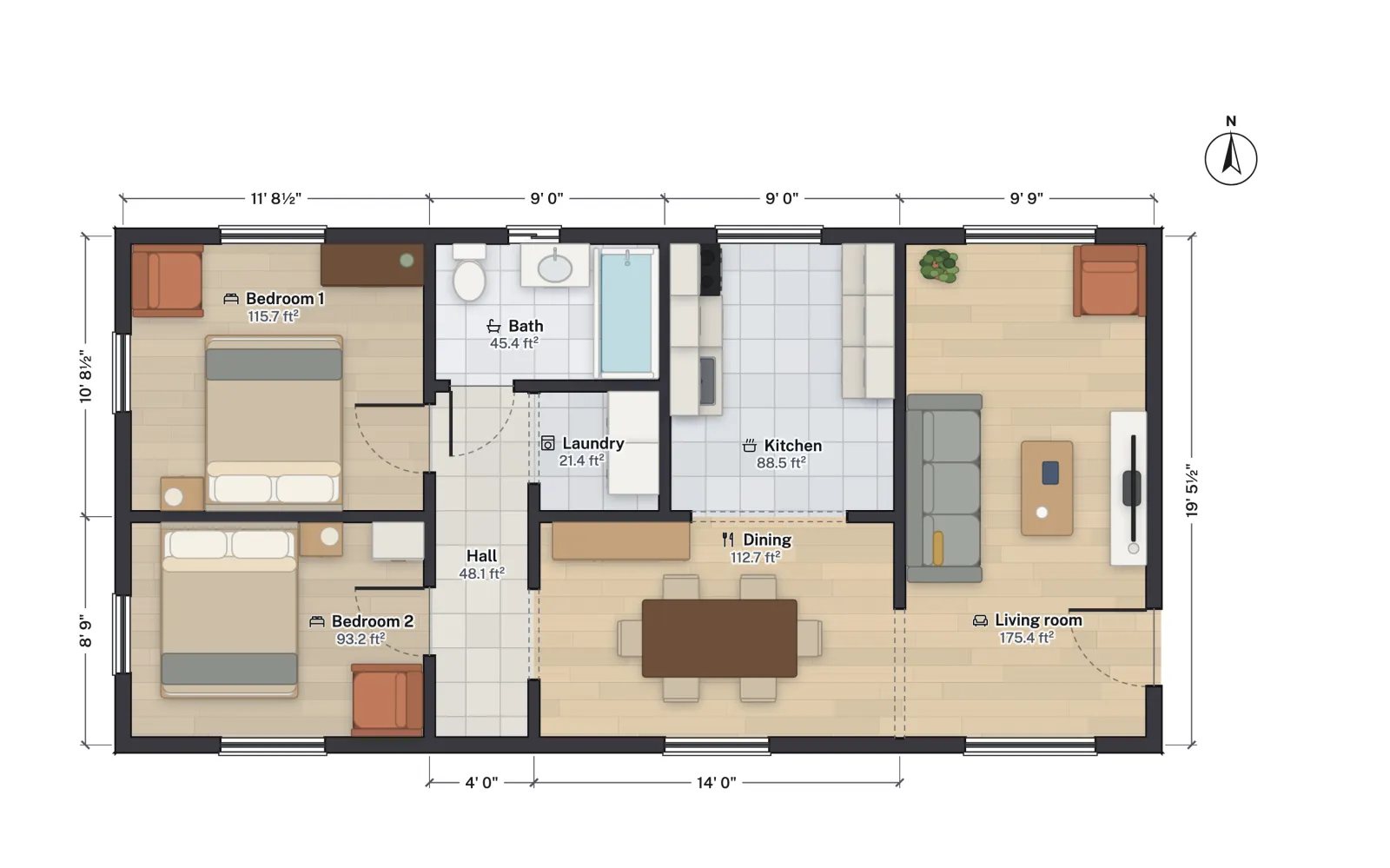
| Room | Net area |
|---|---|
| Bedroom 1 | 115.7 |
| Bedroom 2 | 93.2 |
| Bath | 45.4 |
| Hall | 48.1 |
| Laundry | 21.4 |
| Kitchen | 88.5 |
| Dining | 112.7 |
| Living room | 175.4 |
| Total | 700.5 |
A 40 × 20 ft footprint is long and narrow on purpose: it fits along the back of a typical 50 or 60 ft wide Texas lot with 5 ft side setbacks and leaves the yard open. If your lot is deeper than it is wide, rotate it and put the living room toward the house so the bedrooms face the back fence. On a lot that only allows a smaller unit, take the second bedroom out and you are close to the 400 ft² garage studio.
Building code: the IRC as Texas cities adopt it
Texas law (Local Government Code §214.212) makes the International Residential Code the residential building code in Texas cities, and each city adopts an edition with its own amendments, so check which edition yours uses. A detached ADU is built like a small house under it. The items plan reviewers check most often:
- Habitable rooms other than kitchens at least 70 ft² and 7 ft in any direction (2021 IRC R304; 2024 IRC R312).
- An emergency escape and rescue opening in every sleeping room (2021 IRC R310).
- Smoke alarms in and outside sleeping rooms, and carbon monoxide alarms where there are fuel-burning appliances or an attached garage (2021 IRC R314 and R315).
- Fire separation where the ADU is attached to a garage or sits close to the property line or the main house.
FloorGen's IRC code profile checks room areas and widths, ceiling heights, bedroom escape windows, stairs and door swings as you draw. It does not check alarms, fire separation, setbacks or anything in your deed restrictions. For a full code checklist see what makes a room a bedroom, and for what the permit set should contain see how to draw floor plans for a building permit.
HOAs and deed restrictions come first
Even where a city allows ADUs, an HOA covenant or deed restriction can forbid them, and SB 673 as filed would not have changed that. Read the recorded restrictions for your subdivision (the title company or county clerk can provide them) before paying for drawings. Some HOAs allow a "guest house" with no kitchen but not a rentable unit; others limit the number of structures per lot. If the restrictions are unclear, a real estate attorney can read them for you.
More from the blog
ADUs6 min read
ADU Laws by State: Which States Require Cities to Allow ADUsADUs6 min read
NC ADU Laws: Raleigh, Durham and Charlotte Rules
ADUs5 min read
Florida ADU Rules 2026: The New By-Right Law Explained