Canada5 min readFloorGen team
2025 National Building Code of Canada: What Changes
What the 2025 National Building Code of Canada changes for houses: future-climate values, accessibility, lateral loads, energy tiers and provincial adoption.
The 2025 National Building Code of Canada (NBC 2025) was released on 22 December 2025 by the Canadian Board for Harmonized Construction Codes (CBHCC) and published by the National Research Council (NRC). It is the first edition to build projected future climate into its design values. For houses, the changes that matter are in Part 9: lateral-load bracing, a wider accessibility objective, passive radon stacks and a tiered emissions and energy framework. It has no legal force until your province adopts it, and as of October 2026 the code you build under is still your province’s current edition.
A model code, not a law
The NBC is a model code. The NRC publishes it, but only a province, territory or municipality can make it enforceable, and most adapt it first. Ontario, British Columbia and Alberta each publish their own code (OBC 2024, BCBC 2024, and Alberta’s NBC(AE) 2023, the Alberta edition of the NBC 2020). Adoption dates differ by province, and as the last two sections explain, builders are asking for a pause.
The CBHCC says free electronic copies are in the NRC Publications Archive, and work on the 2030 editions has already begun. The edition numbering is separate from the provincial one: a permit is reviewed under the code in force in your province on the day you apply. For the numbers most houses are measured against today, see stair code in Canada, which cites NBC 2020 and the provincial codes.
Future-climate design values
Earlier editions set snow, wind, rain and temperature design values from historical records. NBC 2025 is the first to add projected climate data covering the next 50 years, in the climatic tables of its Appendix C, for heat, cold, wind, snow and rainfall (the Canadian Centre for Climate Services describes it on ClimateData.ca).
For a house, the effect is indirect. Most small houses are built from Part 9’s prescriptive tables rather than engineered, so you will notice the new values mainly where a municipality’s design data feeds a roof, a gutter or a cooling load. Check the table for your own town.
Part 9 changes for houses
- Lateral loads. Part 9 bracing now depends on a seismic parameter called S_max, which CHBA material says is tabulated in Table C-3 of the code. CHBA also says the exemptions for low-wind, low-seismic locations were removed, so every house needs bracing. We did not check the clause text itself. BC already moved first: BCBC 2024 brought in its own bracing rules from March 2025.
- Accessibility. The accessibility objective now covers all types of dwelling units, but provinces and territories can adjust how it applies. Your province decides how, and whether, it applies to a detached house.
- Radon. A passive vertical radon stack is required in dwelling units.
- Energy and emissions. A harmonized framework for reducing operational greenhouse gas emissions, with performance levels each province chooses from. Industry material describes prescriptive trade-off paths for the upper tiers. Energy efficiency requirements also now apply to alterations of existing buildings, in a new Part 10.
The energy tiers are the least settled. They are a menu: a province decides which tier to require and when. The numbers behind each tier are in Part 9’s energy section, so read it for your province.
The builders’ push to pause
The Canadian Home Builders’ Association (CHBA) has called for the 2025 codes to be suspended, and BILD Alberta, a builders’ association, has asked Alberta to pause adoption. These are the associations’ positions, and the cost figures below are their own estimates, not government figures.
| Source | Estimate |
|---|---|
| BILD Alberta, non-energy changes | $17,852 to $39,668 |
| BILD Alberta, with a move to energy Tier 5 | More than $128,000 |
These are one association’s figures for one house model, and we could not check its method. Codes Canada’s own analysis of the proposed changes is the other side of this argument; read both before deciding what a code change costs on your job.
Which provinces have adopted it
As of October 2026 we could not confirm that any province has put the 2025 edition into force for houses. What the sources show:
- British Columbia: we found no announced date for adopting the 2025 edition. BCBC 2024 applies to permit applications from 10 March 2025.
- Ontario: OBC 2024 took effect on 1 January 2025 and is Ontario’s own code, not the 2025 NBC. We found no announced date for the 2025 edition.
- Alberta: we found no adoption date. BILD Alberta has asked for a pause.
- Elsewhere: government pages indicate Saskatchewan has proposed 1 January 2027 and Yukon has postponed adoption to 22 June 2027. Manitoba is expected to adopt with local amendments. We did not confirm other provinces.
A basement suite, measured
Code editions matter most when you renovate. FloorGen’s basement secondary suite has a net floor area of 77.9 m² (838 ft²). It measures 11.75 × 7.48 m (38 ft 6½ in × 24 ft 6½ in) outside the walls, and 11.42 × 7.15 m inside. Dimension strings in the 2D image run along wall centrelines; room areas are net, to the inner wall faces.
| Room | Area |
|---|---|
| Living room | 20.8 m² (224 ft²) |
| Bedroom | 13.5 m² (145 ft²) |
| Dining | 13.6 m² (146 ft²) |
| Storage / furnace room | 11.3 m² (122 ft²) |
| Kitchen | 6.5 m² (70 ft²) |
| Hall | 5.9 m² (64 ft²) |
| Bath | 4.4 m² (48 ft²) |
| Laundry | 2.0 m² (21 ft²) |
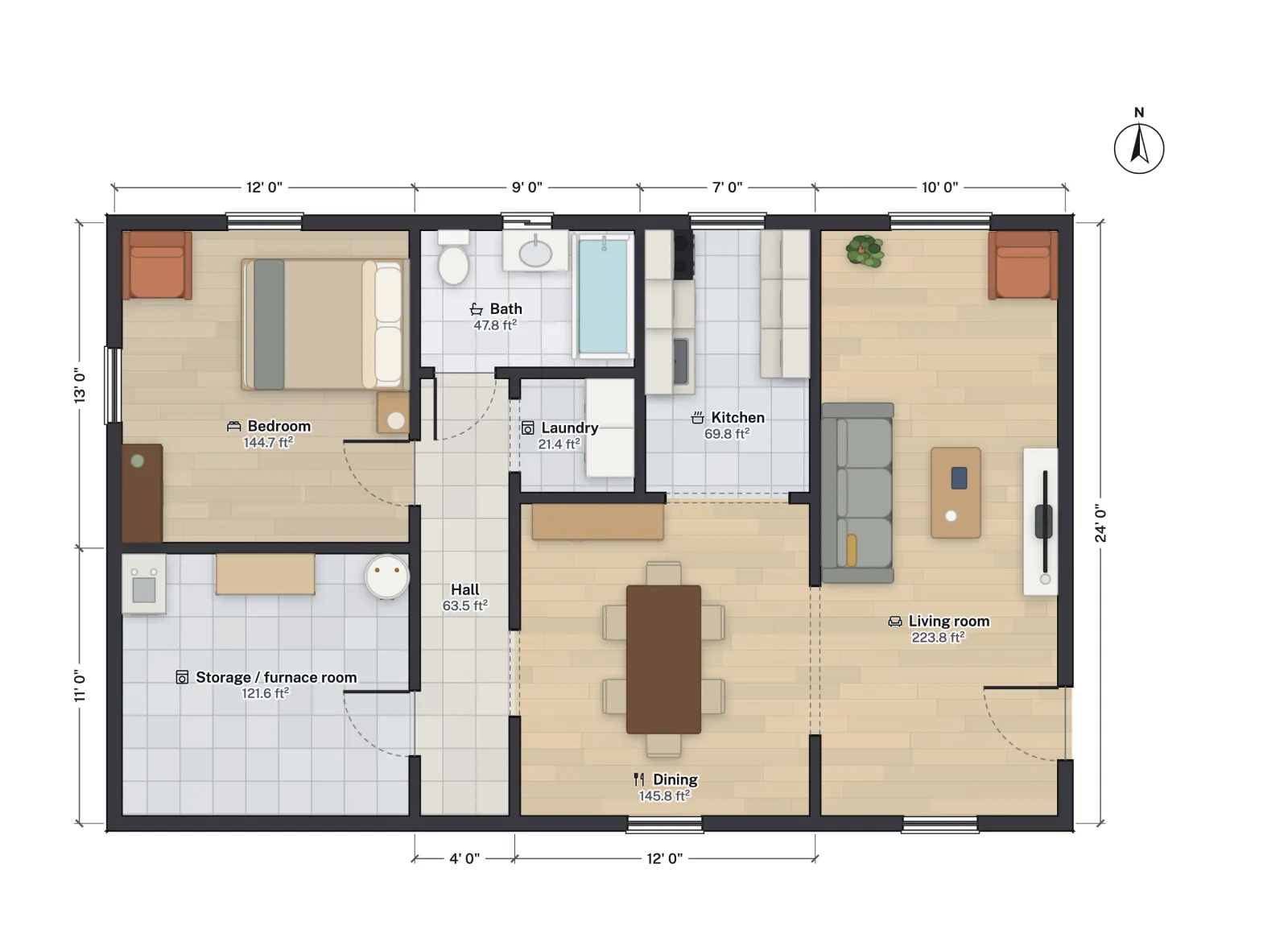
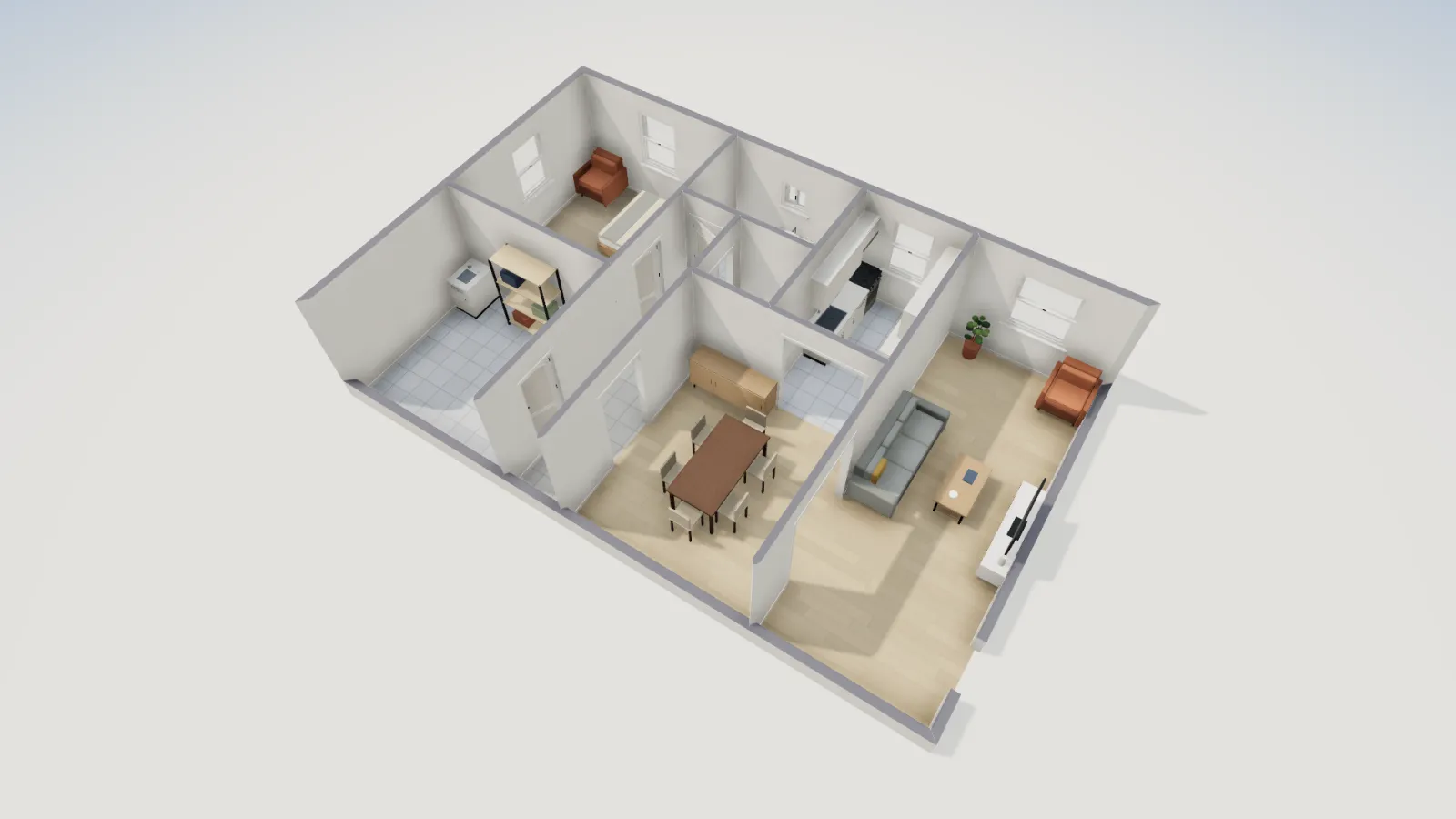
Nothing in this plan changes because of NBC 2025 alone; the edition that applies is your province’s. The checks that bite in a basement are the same ones the older editions set: ceiling height, the bedroom size and window and the stair. When you convert dimensions between feet and millimetres, see metric vs imperial floor plans in Canada. For Alberta’s rules for suites, see Alberta secondary suite requirements.
More from the blog
Canada6 min read
Minimum Basement Ceiling Height: Canada (NBC) and US RulesCanada6 min read
Minimum Bedroom Size in Canada: Ontario, BC and the NBC
Canada6 min read
Deck Permits and Guard Heights in Ontario (OBC)