Codes7 min readFloorGen team
2024 IRC Changes That Affect Your House Plans
What changed in the 2024 IRC for house plans: the Chapter 3 renumbering (2021 to 2024 section table), stair landings, sleeping lofts, and which states use it.
The 2024 International Residential Code (IRC) kept most of the 2021 numbers a floor plan depends on, such as a 70 ft² minimum room, a 7 ft ceiling and a 5.7 ft² escape window, but it renumbered Chapter 3, so the section you cite for egress, stairs, guards or smoke alarms is probably different. A few rules also changed. Whether any of this binds your project depends on which edition your state or city has adopted, so this page covers the section table, the plan-affecting changes and where adoption stands.
What the 2024 edition changed in Chapter 3
The International Code Council (ICC) reorganized Chapter 3 so related topics sit together. In the ICC's own training summary the order is now structure and passive fire resistance (R301 to R308), then active fire protection, meaning sprinklers and smoke and carbon monoxide alarms (R309 to R311), then rooms and spaces (R312 to R317), then means of egress (R318 to R321), then accessibility and elevators (R322 and R323), then home-safety sections such as glazing, ventilation, sanitation and pools (R324 to R328), and last solar, storage, generators and other energy systems (R329 to R332). The practical effect is that most of the sections other posts cite moved by a few numbers, and some by a lot.
Appendices were renumbered too. They are now grouped as administrative appendices (AA, AB), building appendices (BA to BO) and plumbing, mechanical and gas appendices (CA to CH), with energy appendices (NA to NE). The existing-buildings appendix, formerly AJ, became Appendix BO.
Old and new section numbers
This is the table to use when a FloorGen post, a permit set or an old checklist cites a 2021 number. Section numbers are from the ICC's Chapter 3 reorganization table for the 2024 IRC, with the egress, handrail and guard rows also seen in state amendment documents that cite the 2024 numbers. Rows we could not confirm are left out.
| Topic | 2021 IRC | 2024 IRC |
|---|---|---|
| Means of egress, including stairways | R311 (stairs R311.7) | R318 (stairs R318.7) |
| Emergency escape and rescue openings | R310 | R319 |
| Handrails | R311.7.8 (within stairways) | R320 |
| Guards | R312 | R321 (now Guards and Window Fall Protection) |
| Smoke alarms | R314 | R310 |
| Carbon monoxide alarms | R315 | R311 |
| Garage and dwelling separation, openings | R302.5 and R302.6 | R302.5 and R302.6 (unchanged) |
| Topic | 2021 IRC | 2024 IRC |
|---|---|---|
| Minimum room areas | R304 | R312 |
| Ceiling height | R305 | R313 |
| Mezzanines | R325 | R314 |
| Sleeping lofts | none | R315 (new) |
| Habitable attics | R326 | R316 |
| Garages and carports | R309 | R317 |
| Sanitation | R306 | R326 |
| Toilet, bath and shower spaces | R307 | R327 |
| Glazing (safety glass) | R308 | R324 |
| Light, ventilation and heating | R303 | R325 |
Two cautions. First, subsections move with their section: 2021 stair landings in R311.7.6 are R318.7.6 in 2024 (ICC), and the same pattern holds for most other subsections, so look up the subsection rather than assuming the last digits carry over. Second, an early set of ICC training slides lists a draft numbering for several sections (guards and garages among them), so use the final table above, not an early handout. The garage door and drywall rules did not move at all; see the garage fire separation rules.
Rule changes that touch a floor plan
Stairs
The riser, tread, width and headroom limits did not change. What changed is the detail around landings (2024 IRC R318.7.6, was R311.7.6): the ICC lists the exceptions as grouped in one section: a top landing may be on the opposite side of a door, a landing may be up to 7¾ in below the threshold, no top landing is needed for a stair with fewer than three risers, and an exterior stair to grade must have a bottom landing. Alterations to an existing stair need not meet the new-stair slope limits where the existing space does not allow it (R318.7.9). The text of each exception has conditions, so read the adopted section before relying on one. The dimensions themselves are in the stair code guide.
Sleeping lofts
Sleeping lofts are a new section (2024 IRC R315). To count as one, the space must be under 70 ft², with a ceiling above 7 ft over no more than half its floor area, at least 3 ft of ceiling over the area that counts as loft floor, and 7 ft clear below it. A loft under 3 ft deep, under 35 ft², or without a permanent means of egress falls outside the section. These figures follow published summaries of R315; read the section in your adopted edition. If your loft is bigger than this, it is a different kind of space, usually a mezzanine or a habitable attic. See loft and mezzanine rules.
Smoke alarms, guards and garages
The ICC lists two changes to smoke alarms (2024 IRC R310): installation must follow the manufacturer's instructions, and the location text was clarified. The requirement for alarms in every sleeping room, outside each sleeping area and on every level stays. Where to put them and carbon monoxide alarm placement cover the layout. For guards, the section now includes window fall protection in its title, and the ICC lists new details for bracing the floor edge where a guard attaches (R502.11, roll bracing), which matters on a balcony, loft or open stair landing. Garages gain provisions for EV charging equipment and automotive lifts (R317.6 and R317.7).
Remodels and existing houses
The ICC says the requirements in the existing-buildings appendix (Appendix BO, formerly AJ) were expanded. Appendices apply only where a jurisdiction adopts them, so if you are drawing a renovation, ask your building department whether it has and what it requires.
The energy chapter
Energy efficiency follows the International Energy Conservation Code (IECC), which is separate from the building chapters. The U.S. Department of Energy found that the 2024 IECC improves residential efficiency over the 2021 edition, estimating about 7.8% site energy savings nationally (Federal Register, 30 December 2024). On the plan, the visible effects are mostly in the wall and ceiling assemblies and glazing in the specification, not in room sizes. Check your state's energy code, because it can be on a different edition from its residential code.
A plan checked against the new numbers
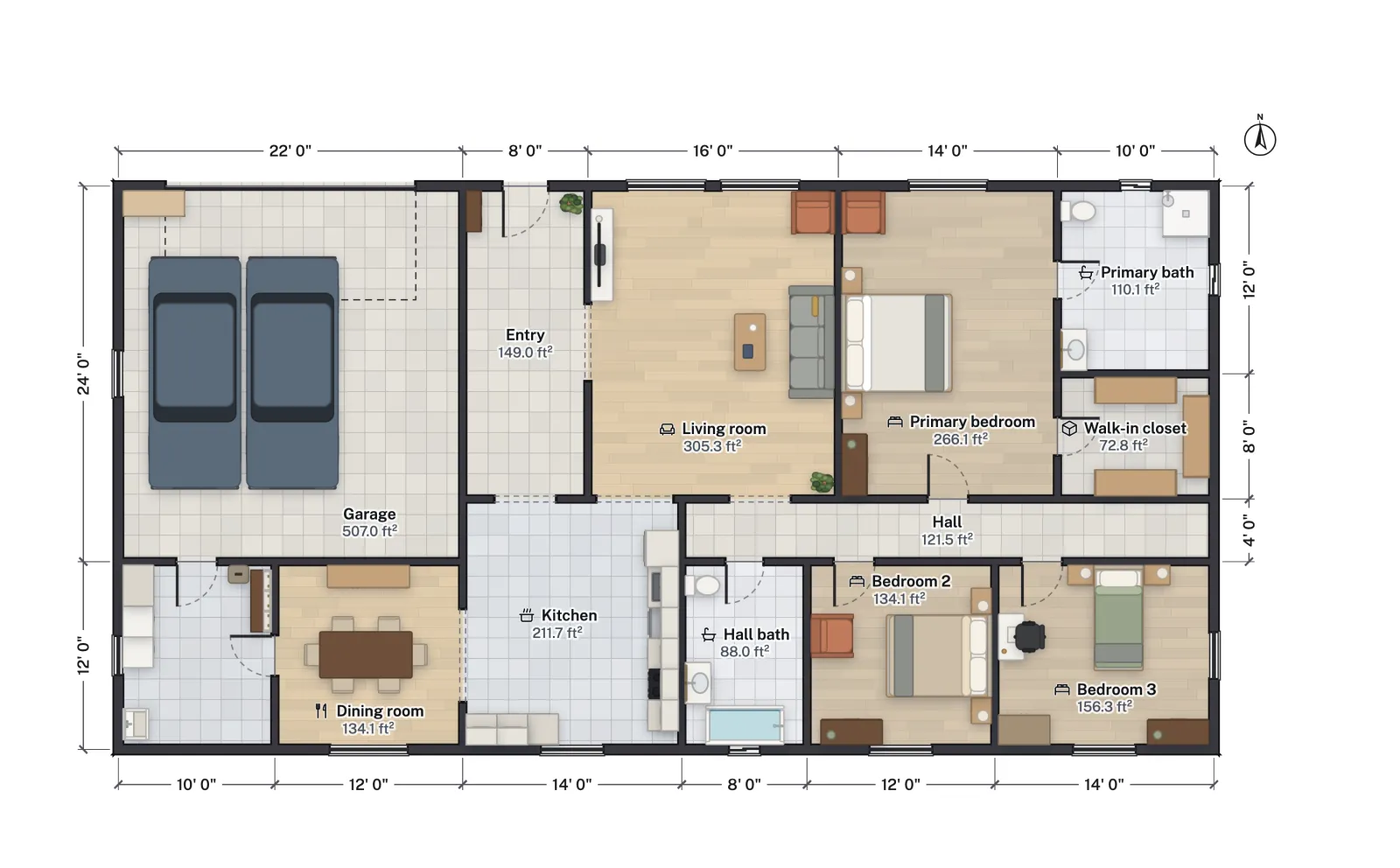
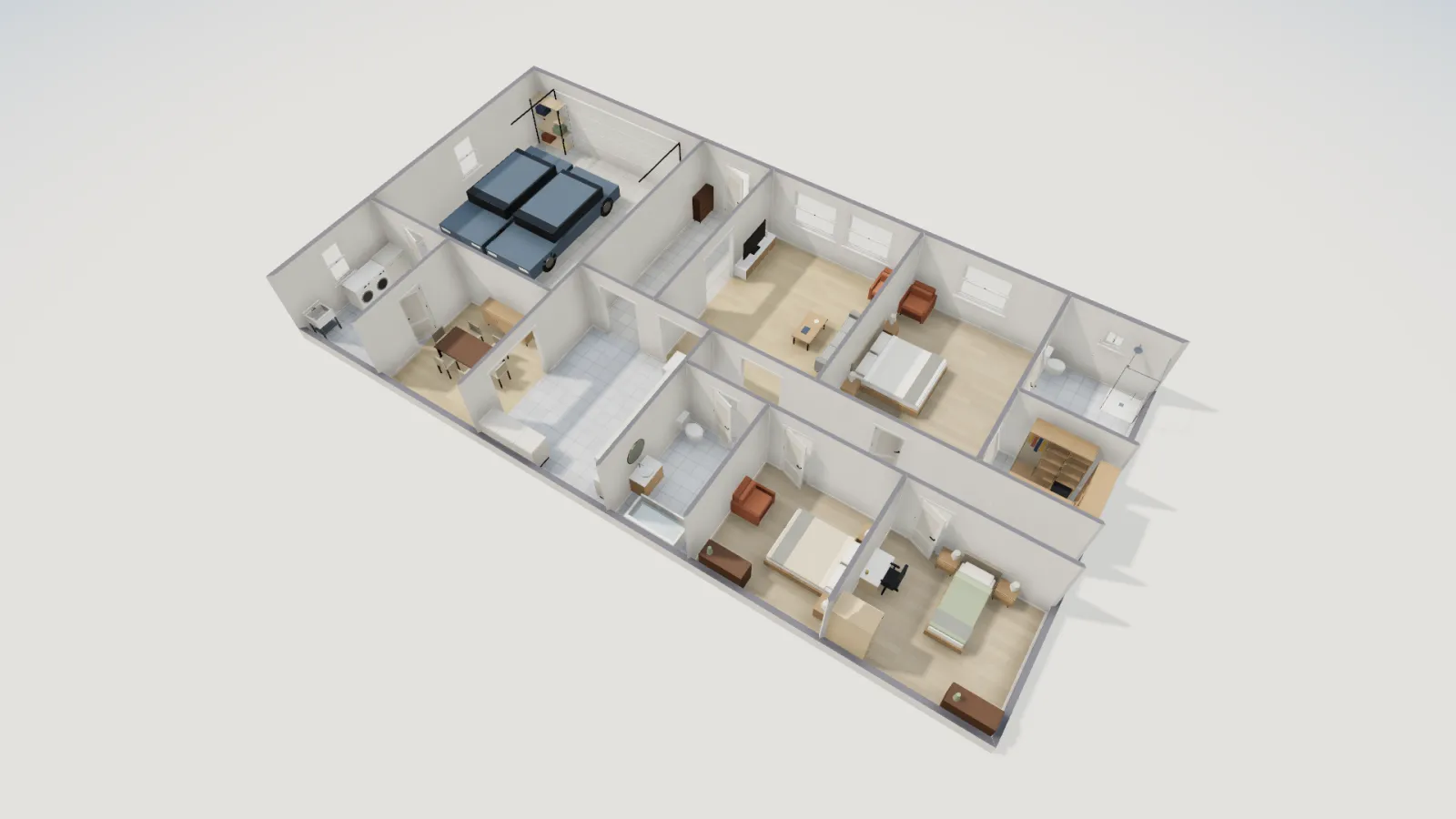
Take the single-storey ranch template. Its three bedrooms net 266.1 ft² (primary), 134.1 ft² (bedroom 2) and 156.3 ft² (bedroom 3), all comfortably over the 70 ft² minimum in 2021 IRC R304 / 2024 IRC R312. Room areas on the image are net, measured to the inside wall faces, and the dimension strings run along wall centrelines. The 507 ft² garage is separated from the house under R302.5 and R302.6 in both editions. Bedrooms 2 and 3 and the primary bedroom each need an escape opening (2021 IRC R310 / 2024 IRC R319) and alarms in and outside the sleeping area (2021 IRC R314 / 2024 IRC R310). Whether a given window meets the net opening (5.7 ft², or 5.0 ft² for a grade-floor opening like these) depends on the unit you pick, so check the manufacturer's net clear opening, not the rough opening.
Which edition applies to you
The ICC publishes the model code; states and cities decide when to adopt it and what to amend. The picture below is as of 13 October 2026, and it moves quickly, so confirm with your building department before relying on it.
| State | Status |
|---|---|
| California | 2025 California Residential Code, based on the 2024 IRC, effective 1 January 2026 |
| Florida | 9th Edition (2026) Florida Residential Code, based on the 2024 codes, effective 31 December 2026; the 8th Edition (2023) is IRC 2021-based |
| Georgia | 2024 IRC with Georgia amendments, effective 1 January 2026 (Georgia DCA notice, 1 December 2025) |
| Oklahoma | 2024 IRC with Oklahoma amendments, statewide minimum effective 14 September 2026 |
| Texas | TDLR moved its air-conditioning contractor rules to the 2024 IRC, IMC and IFGC in August 2026; that is not a statewide code for houses, which follow the edition each city adopts |
| Washington | The 2021-based code took effect 15 March 2024; the state council lists 3 May 2027 as the effective date of the 2024 codes, with final adoption targeted for October 2026 |
Several states, Colorado among them, have no statewide residential code, so it is the city or county that counts. Where a place is still on 2021, use the 2021 numbers in the table; where it is on 2024, use the new ones; where you do not know, the safe habit is the one these posts use, which is to cite both. The legal bedroom guide is a good example of a post that does.
More from the blog
Codes6 min read
Deck Railing Height Code: IRC Guard and Handrail RulesCodes6 min read
Attic and Crawl Space Access Size: IRC Opening Rules
Codes7 min read
Tempered Glass Code: Where Safety Glazing Is Required